
Walk into any well-designed retail store and you'll notice something beyond the products themselves — there's a deliberate flow to the space. Customers move in a pattern. Certain products catch the eye before others. Impulse purchases happen at specific spots. None of this is accidental.
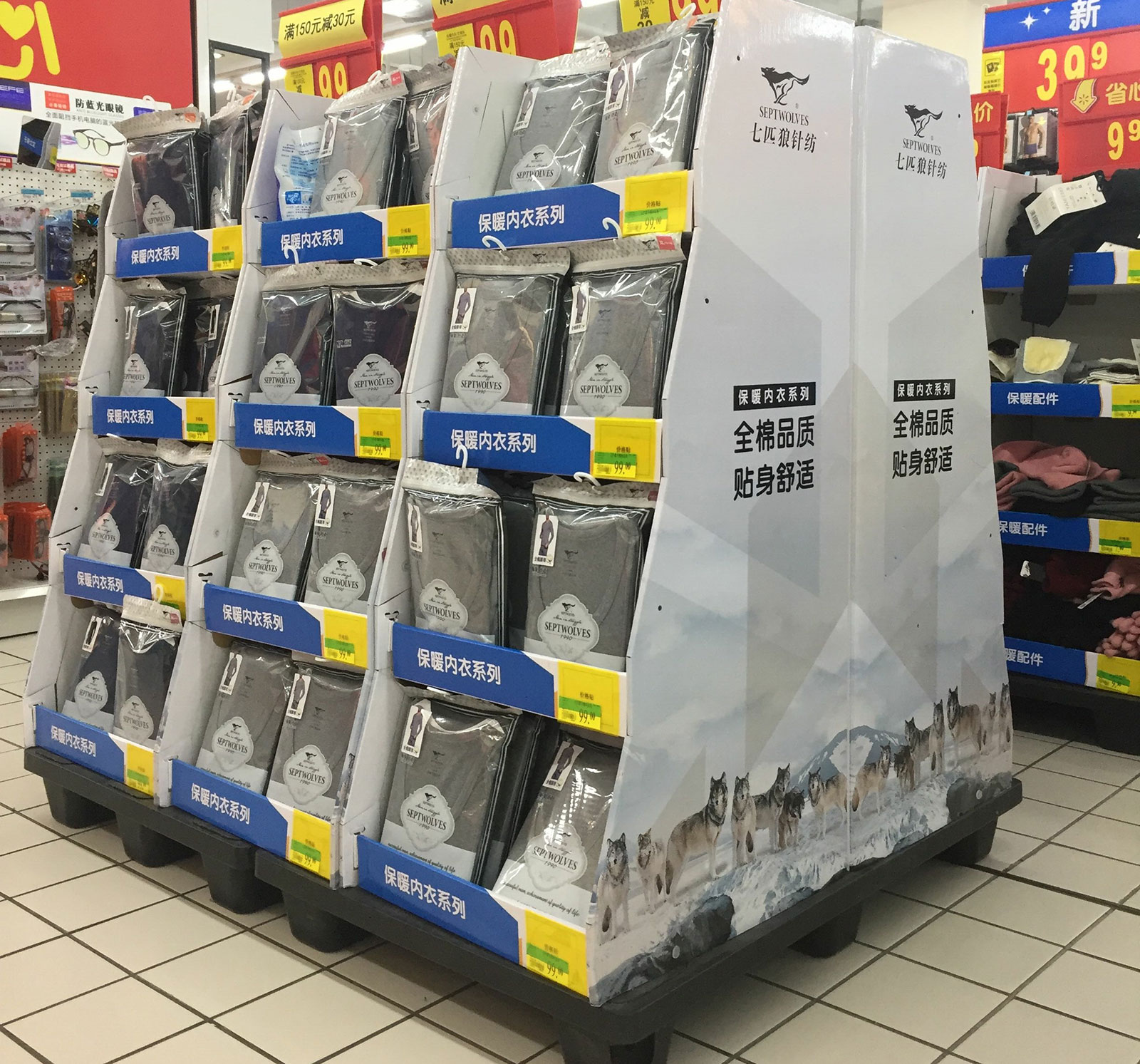
Retail store layout is one of the most powerful — and most underestimated — tools in a brand's arsenal. And when you combine smart layout design with the right cardboard displays, the results can be significant. Studies consistently show that point-of-purchase (POP) displays can boost product sales by up to 20%. For brands competing on tight margins in crowded retail environments, that's a number worth taking seriously.
- What Is a Cardboard Retail Display?
- Why Store Layout Comes First
- The 9 Retail Store Layout Types and the Best Cardboard Displays for Each
- 1. Grid Layout
- 2. Loop / Racetrack Layout
- 3. Forced-Path Layout
- 4. Free-Flow Layout
- 5. Angular Layout
- 6. Geometric Layout
- 7. Diagonal Layout
- 8. Straight / Spine Layout
- 9. Boutique Layout
- A Practical Guide to Cardboard Display Types
- Five Design Principles That Make Cardboard Displays Work
- How to Measure Whether Your Display Is Actually Working
- Choosing the Right Partner Matters
- Final Thoughts
This guide breaks down the most common retail store layout types, how each one influences shopper behavior, and which cardboard display formats work best within each environment.
What Is a Cardboard Retail Display?
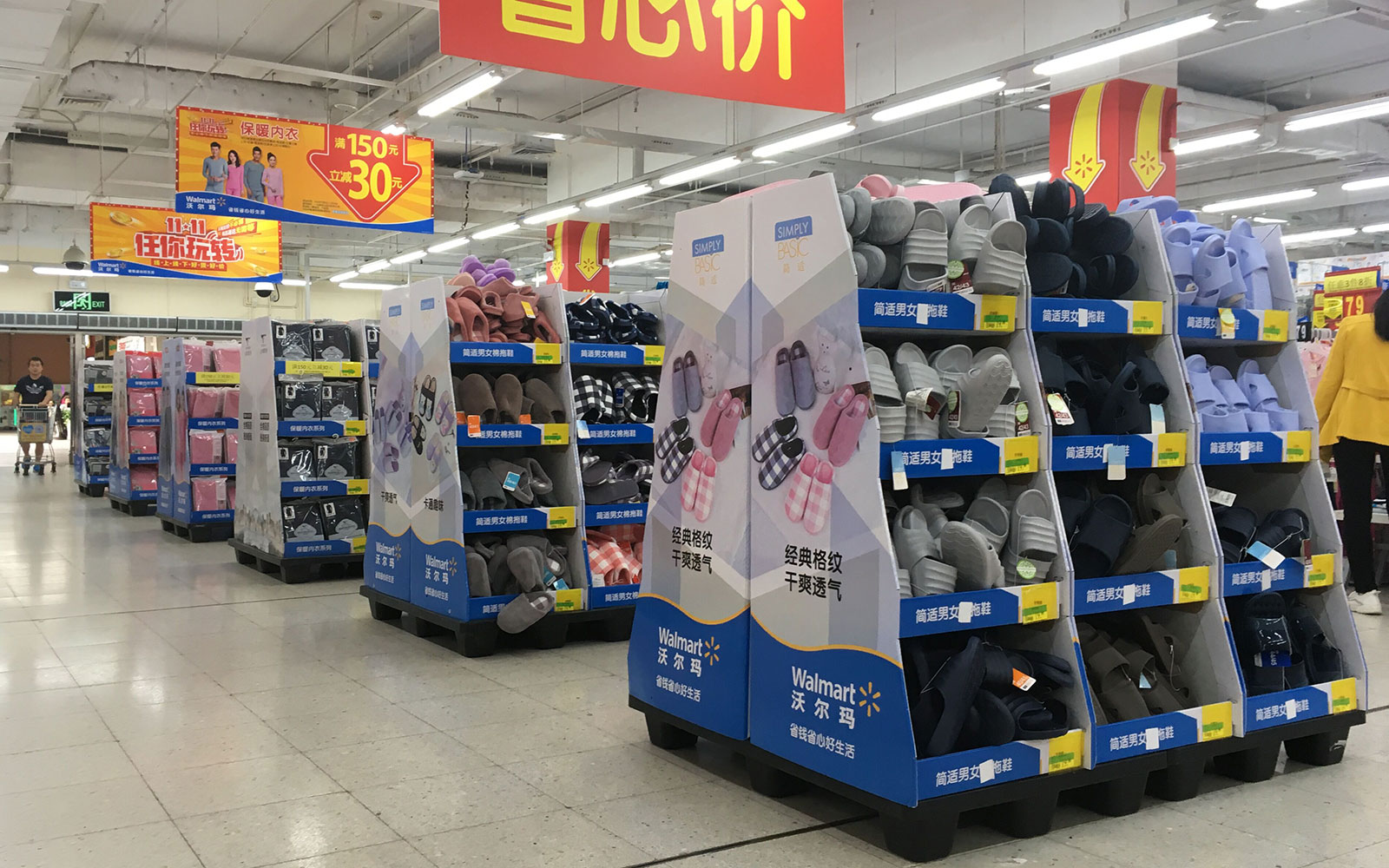
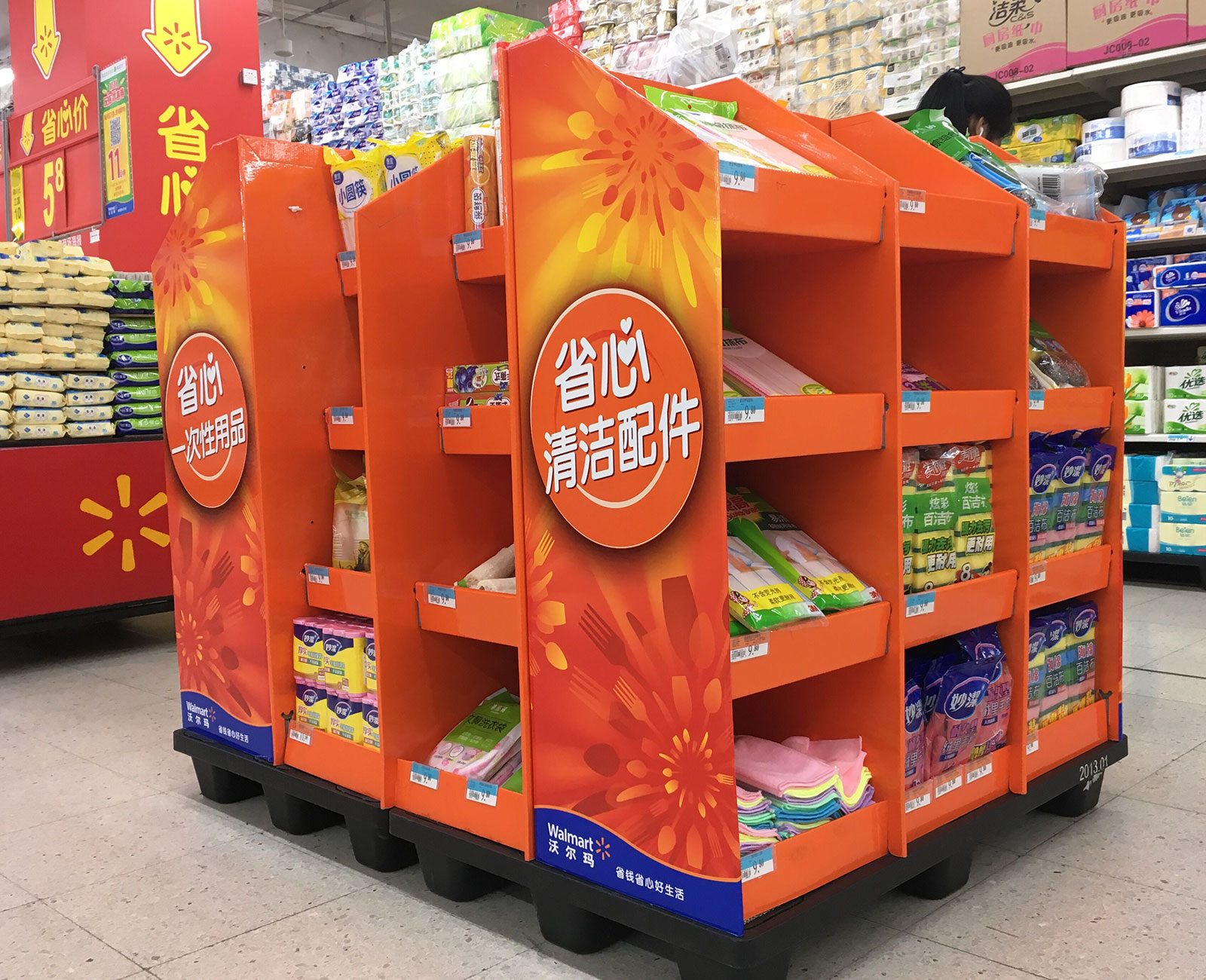
A cardboard retail display — also called a corrugated POP display — is a temporary or semi-permanent product presentation structure made from corrugated paperboard. Unlike permanent metal or acrylic fixtures, cardboard displays are designed to be cost-effective, fast to produce, easy to ship flat, and simple to assemble in-store.
They serve a clear purpose: place the right product in front of the right customer at the right moment. Whether that's a freestanding floor unit in the middle of an aisle or a small counter display at the checkout, every cardboard display is a selling tool.
It's worth clarifying one common point of confusion — POP vs. POS displays:
| POP Display | POS Display | |
|---|---|---|
| Location | Anywhere in the store | At the checkout/payment counter |
| Purpose | Brand awareness + impulse purchase | Last-minute impulse purchase |
| Example | Endcap floor display | Counter display with snacks or accessories |
Both types are widely manufactured from corrugated cardboard, which makes them affordable, recyclable, and easy to customize with full-color graphics.
Why Store Layout Comes First
Before selecting a display format, it's essential to understand the store's floor plan. Layout determines foot traffic patterns, dwell time in specific zones, and where customers are most likely to make unplanned purchases.
Research in retail psychology consistently shows that most shoppers in Western markets turn right upon entering a store and tend to move counterclockwise. Retailers who understand this design their floor plans and display placement accordingly — placing high-margin or promotional products along the natural path of travel.
There are nine recognized retail store layout types, and each creates a different opportunity for cardboard displays.
The 9 Retail Store Layout Types and the Best Cardboard Displays for Each
1. Grid Layout
The grid layout is the most familiar — think supermarkets and drug stores. Long parallel aisles guide shoppers from one end of the store to the other in an organized, predictable pattern.
Best cardboard displays: Endcap displays at the end of each aisle are the gold standard here. Pallet displays work well in wide center aisles. Sidekick or power wing displays attached to shelving units allow brands to claim extra facings without disrupting the overall structure.
Why it works: In a grid layout, customers are often on a mission to find specific items. Endcaps interrupt that mission in a good way — they're the natural resting point at the end of each aisle, where shoppers pause and look around.
2. Loop / Racetrack Layout
The loop layout creates a defined pathway that guides customers around the perimeter of the store before leading them back to the entrance. Brands like Costco and many department stores use variations of this approach.
Best cardboard displays: Freestanding floor displays placed along the inner loop path work exceptionally well. Power wing (sidekick) displays positioned at key turning points in the loop catch shoppers as they slow down to change direction.
Why it works: The looping path guarantees high exposure for anything placed along it. Brands that position cardboard displays at these "turning point" moments benefit from high dwell time and strong visibility.
3. Forced-Path Layout
IKEA is the most famous example of a forced-path layout — shoppers follow a single predetermined route through the entire store. There's no shortcut.
Best cardboard displays: Temporary promotional displays and endcap-style structures placed at the "pause points" (room transitions, product category shifts) are highly effective. Since customers have no choice but to walk past, every display gets seen.
Why it works: In a forced-path environment, any brand that secures a display placement is virtually guaranteed eyeballs. This makes the creative quality of the display itself — its graphics, messaging, and structural interest — especially important.
4. Free-Flow Layout
The free-flow layout gives customers no defined route. Found in boutique clothing stores and gift shops, the space is open and inviting, encouraging exploration at the shopper's own pace.
Best cardboard displays: Counter displays, small freestanding floor displays, and branded impulse racks work well here. Since there's no forced path, displays need to be independently eye-catching to draw customers in.
Why it works: Free-flow shoppers are browsers, not mission-driven buyers. Visually engaging, well-branded cardboard displays act as curiosity triggers — they invite customers to pick something up, read it, and make an unplanned purchase.
5. Angular Layout
Angular layouts use curved shelving, angled product arrangements, and non-linear floor plans to create a premium, high-end feel. Common in cosmetics, electronics boutiques, and luxury retail.
Best cardboard displays: Custom-shaped freestanding displays with upscale finishing — matte lamination, embossing, spot UV coating — complement the aesthetic. The display itself must look like it belongs in an elevated environment.
Why it works: In angular stores, the display isn't just a product holder — it's part of the brand experience. Cardboard, when executed well, can look just as premium as acrylic or wood, at a fraction of the cost.
6. Geometric Layout
Similar to angular layouts but more pattern-driven, geometric store designs use shapes and symmetry to create visual interest. Often found in trendy lifestyle and fashion retailers.
Best cardboard displays: Sidekick displays and power wings that echo the geometric aesthetic of the store environment. Displays with structural angles or cutout silhouettes integrate well.
7. Diagonal Layout
The diagonal layout arranges aisles and shelving units at 45-degree angles to the walls, which improves sightlines across the store and makes it easier for staff to monitor the floor.
Best cardboard displays: Pegboard hook displays and inline corrugated displays that can be positioned between diagonal shelving runs are practical here. The angled flow means customers naturally see displays from multiple directions.
8. Straight / Spine Layout
A single main aisle runs down the center of the store — the "spine" — with smaller secondary aisles branching off on either side. Common in specialty retailers and some drug stores.
Best cardboard displays: Endcap displays, dump bins, and inline corrugated displays along the central spine capture the highest traffic. The spine itself acts like a highway — the most valuable real estate in the store.
9. Boutique Layout
The boutique layout divides the store into smaller, distinct "rooms" or sections, each with its own theme or product category. It encourages customers to discover and explore.
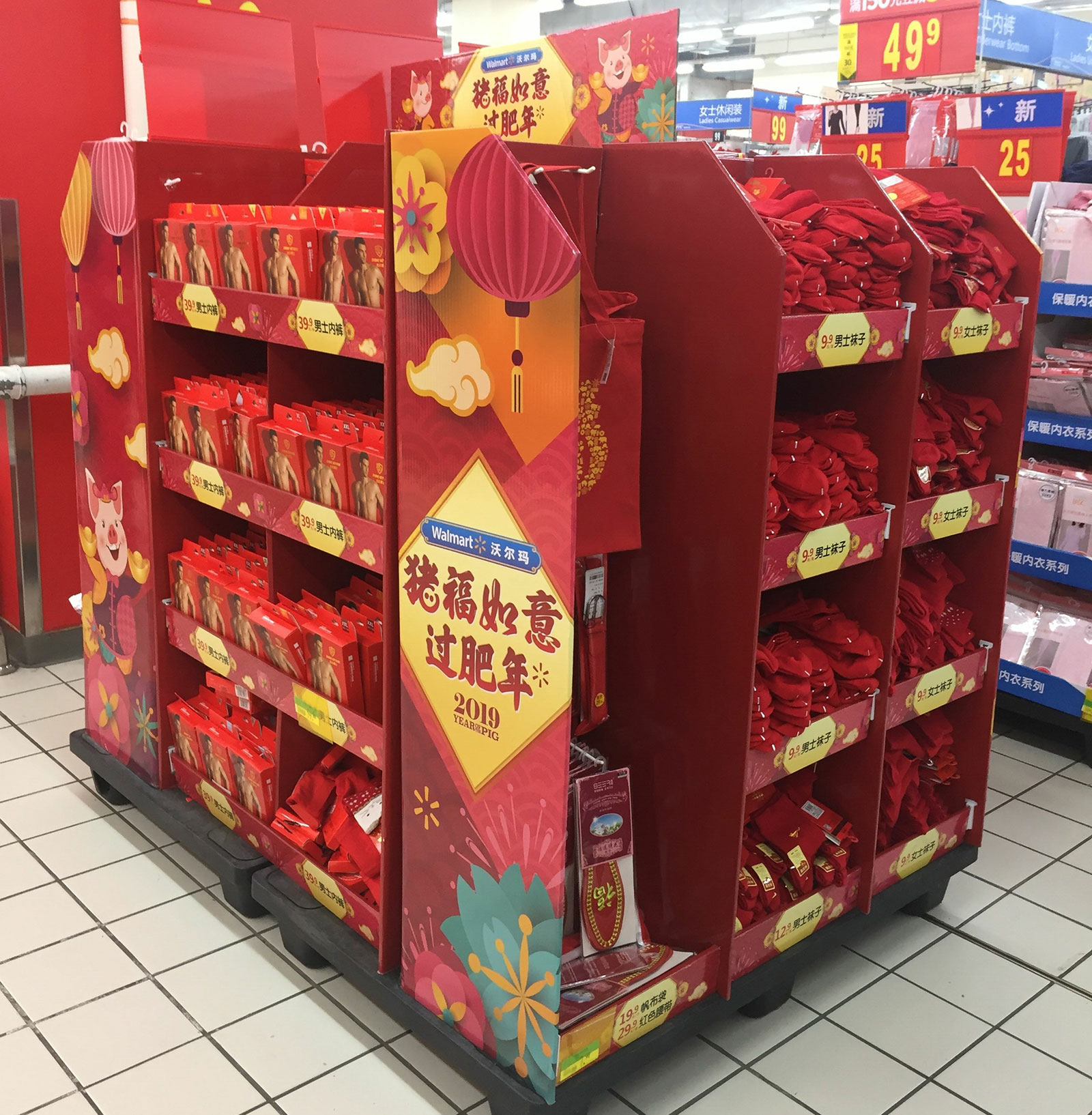
Best cardboard displays: Fully custom freestanding displays designed specifically for each boutique zone. Themed displays — seasonal packaging, limited-edition collections — perform well in boutique environments where storytelling drives purchase decisions.
A Practical Guide to Cardboard Display Types
Once you understand your store's layout, choosing the right display format becomes more intuitive. Here's a quick-reference breakdown of the most widely used types:
-
Floor/Freestanding Displays — The most versatile format. Placed in high-traffic zones independently of existing shelving. Suitable for nearly every layout type.
-
Endcap Displays — Positioned at aisle ends. Extremely high visibility. The most competitive display real estate in grid-layout stores.
-
Counter / POS Displays — Small-footprint units at the checkout. Best for small, low-cost impulse items — candy, batteries, accessories.
-
Sidekick / Power Wing — Attaches to the side of existing shelving. Space-efficient and effective for secondary product placements without requiring floor space.
-
Dump Bins — Open-top bins for bulk, discounted, or promotional items. High-volume, low-cost, fast-selling products thrive here.
-
Pallet Displays — Large-volume displays shipped on a pallet, common in warehouse and club stores. Designed for high inventory loads.
-
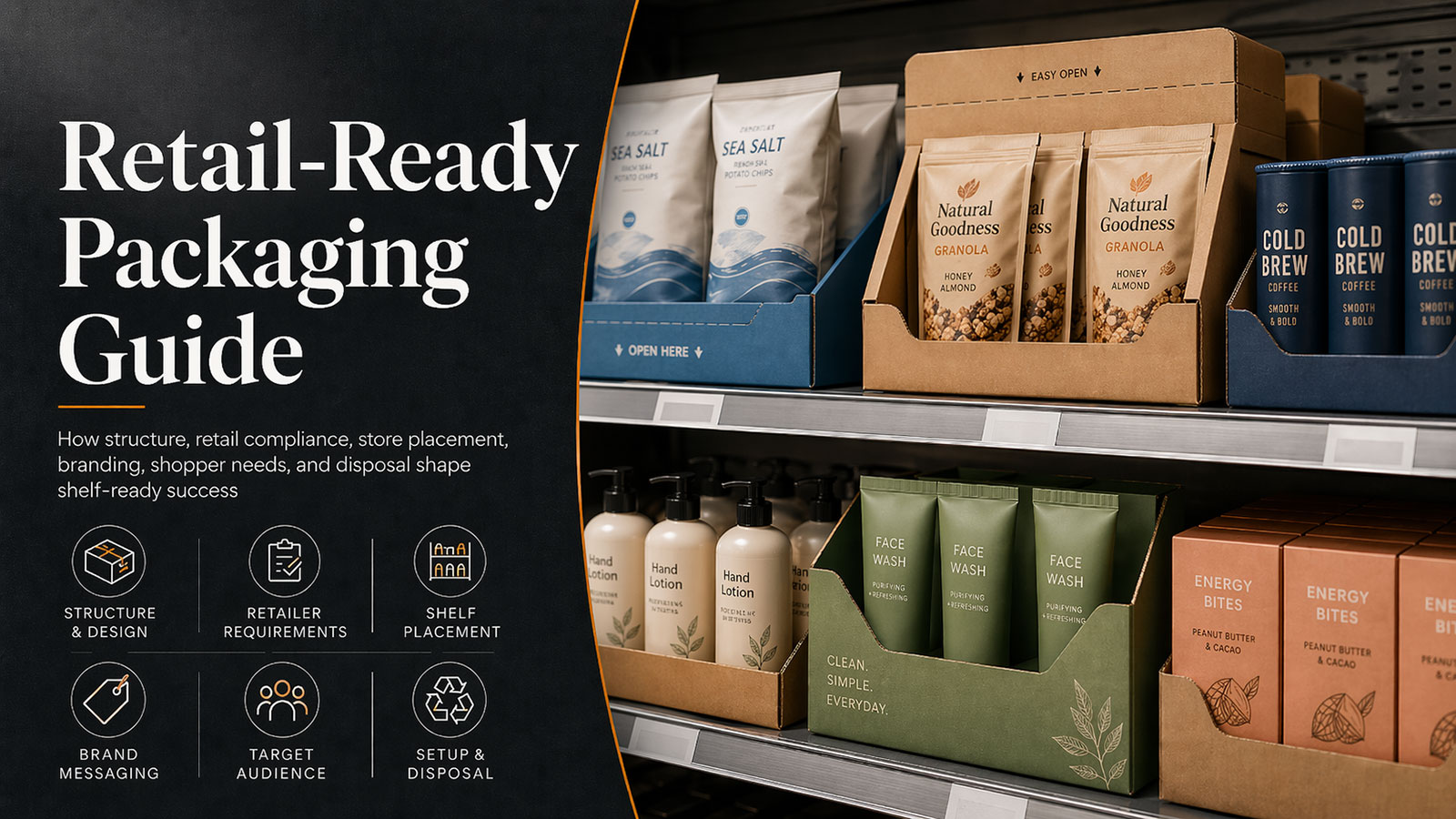
PDQ / Shelf-Ready Trays — Boxes that double as shelf displays. Shipped pre-loaded with product; staff simply place them on the shelf. Speeds up restocking significantly.
-
Cutout Standees / Freestanding Graphics — Life-size or oversized cardboard characters and graphics for brand awareness campaigns. Not primarily for product holding but powerful for attention.
Five Design Principles That Make Cardboard Displays Work
A well-placed display with mediocre design is a missed opportunity. These principles separate effective displays from forgettable ones:
1. Lead with the brand, not the product name. Shoppers process visual identity before they read text. The brand logo, color palette, and hero image should communicate the product's value proposition in under two seconds.
2. Keep copy short and punchy. The average shopper spends three to five seconds looking at a display. One headline, one benefit, one call to action. Everything else is noise.
3. Match the display structure to the product's weight and volume. A single-wall corrugated display won't hold heavy canned goods. Choosing the right flute grade (B, C, BC double-wall) ensures structural integrity and prevents costly in-store failures.
4. Design for flat-pack shipping. A display that's difficult to assemble won't get set up properly — or at all. Clean, intuitive flat-pack structures with clear assembly instructions protect your investment.
5. Refresh seasonally. A display that's been on the floor for six months becomes invisible. Seasonal graphic updates — without changing the structure — cost relatively little and dramatically reset customer attention.
How to Measure Whether Your Display Is Actually Working
Cardboard displays are an investment. Here's how to evaluate their real-world impact:
-
Sales velocity before vs. after placement — the most direct metric. Did weekly units sold increase after the display went up?
-
Dwell time — are customers spending more time near the display? In-store camera analytics or heat maps can capture this.
-
Sell-through rate — is the display emptying at a healthy rate, indicating strong consumer pull?
-
Reorder frequency — a display that drives consistent reorders signals to the retailer that the format is worth keeping.
-
Side-by-side A/B testing — test two display creative versions in comparable stores and compare results over the same time period.
Choosing the Right Partner Matters
The quality of the final display is only as good as the manufacturing process behind it. When evaluating a corrugated display manufacturer, ask specifically about:
-
In-house structural design and prototyping capabilities
-
Minimum order quantities (especially important for smaller retail rollouts)
-
Lead times from approved artwork to delivery
-
Flat-pack assembly design and testing
-
Sustainability credentials — recyclability, FSC-certified materials
For brands targeting US retail chains, working with a domestic manufacturer offers faster iteration cycles and tighter quality control compared to overseas production — though overseas sourcing remains a strong option for higher-volume, longer lead-time campaigns.
Final Thoughts
Retail store layouts are the architecture of the shopping experience. Cardboard displays are the furniture. Neither works at its best without the other.
Whether you're launching a new product into a grocery chain grid layout, running a seasonal promotion in a boutique environment, or building a permanent power wing program across a national drug store network — the most effective results come from treating display design and store layout as an integrated strategy, not two separate decisions.
The brands that get this right don't just sell more product at launch. They build the kind of in-store presence that earns permanent fixture space over time.